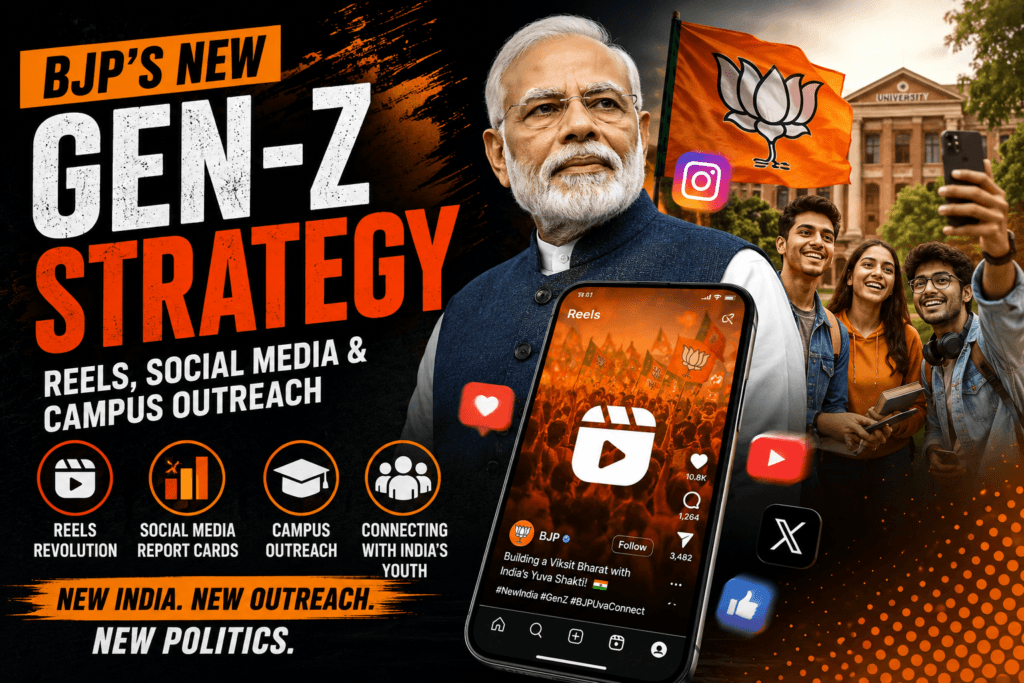
The Narendra Modi government & his party BJP is stepping up its outreach to India’s Gen Z, adopting a more digital-first political communication strategy built around short-form videos, social-media engagement and direct interaction with college students.
The shift comes after youth-led protests exposed the growing political importance of India’s younger generation. According to reports, the government is focusing on Instagram Reels, creator-style content, social-media performance rankings and campus outreach to communicate with younger Indians.
Ministers’ Social Media Performance Under Review
A recent assessment examined the social-media performance of Union ministers between May 1 and August 15, 2026, looking at activity and engagement across platforms including Instagram, X and Facebook. Prime Minister Modi reportedly topped the government’s social-media performance rankings.
The exercise reflects an attempt to make ministers more effective communicators in an environment where younger voters increasingly consume news through social platforms rather than traditional television or newspapers.
Why Reels Matter
The government’s new approach focuses on short, visual and less formal content. Instead of relying entirely on conventional speeches or press conferences, ministers are being encouraged to communicate through formats familiar to younger social-media users.

That includes:
- Instagram Reels
- Short videos
- Behind-the-scenes content
- Direct-to-camera communication
- Social-media explainers
- Creator-style formats
The strategy is aimed particularly at Gen Z, whose media habits are heavily shaped by platforms such as Instagram and YouTube.
“One Day, One University”
One of the most notable elements of the strategy is a planned “One Day, One University” campaign. Under the initiative, Union ministers are expected to travel to universities and interact directly with students.
The objective is to allow ministers to discuss government schemes, answer questions and hear concerns directly from young people. This represents a shift from purely digital outreach toward a combination of online engagement and physical campus presence.
ALSO READ: Rs. 112 Crore “Modi Mandir” in Bihar: Shocking Temple Proposal Sparks Debate
Why BJP Is Focusing on Gen Z
India’s younger voters represent a huge political constituency. For the BJP, the challenge is that Gen Z’s political expectations and communication habits can differ significantly from those of older voters.

Young Indians are more likely to encounter political information through social-media feeds, influencers, memes and short videos. That means traditional political messaging can struggle to capture their attention.
The youth-led protests have also demonstrated that younger Indians can rapidly organise and shape political narratives online.
BJP Is Not Alone
The BJP is not the only political force targeting Gen Z. Opposition parties, including Congress, are also attempting to build stronger youth networks and use social-media platforms to reach younger voters.
The growing competition means India’s next phase of political campaigning could become increasingly digital, personality-driven and campus-focused.
The Bigger Political Question
The new Gen-Z strategy represents more than a change in social-media tactics. it suggests Indian political parties increasingly recognise that winning younger voters may require speaking their language — digitally, visually and directly.
The real test will be whether reels and campus visits translate into sustained political support.
For the Modi government and BJP, the strategy is an attempt to ensure that India’s youngest voters do not remain outside the party’s political conversation.