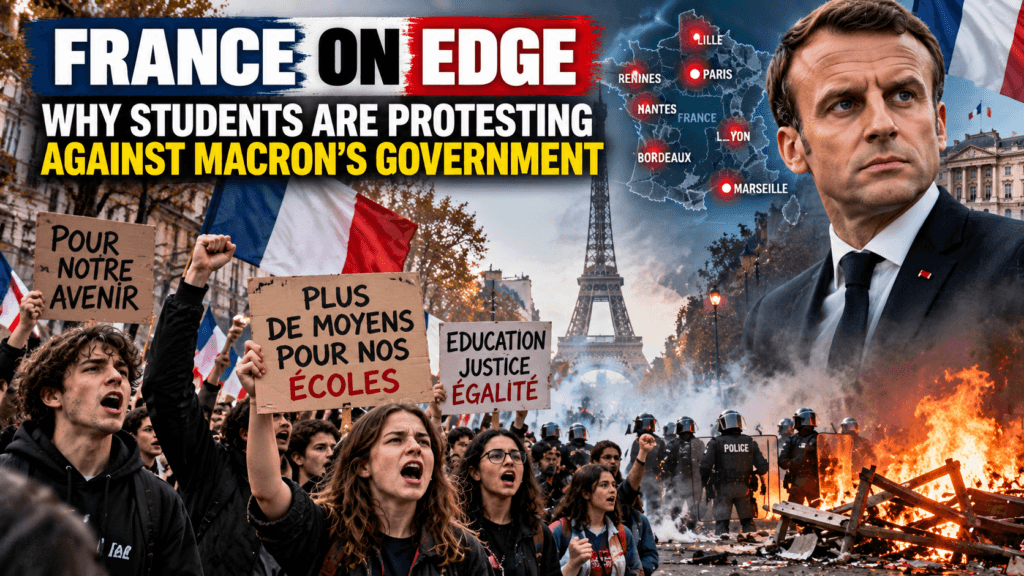
France is facing a growing political and public-order crisis as student-led demonstrations over deteriorating school conditions have expanded into a wider movement against the government’s handling of public services, the cost of living and economic inequality.
The protests, which began around schools in the Paris suburbs in September, have spread to cities across the country, bringing students together with trade unions, public-sector workers and supporters of France’s Yellow Vest movement.
The unrest intensified over the weekend of October 17–18, when demonstrations in several cities were accompanied by looting, vandalism and clashes with police. The violence has put President Emmanuel Macron’s government under renewed pressure, with local leaders questioning whether authorities were adequately prepared.
At the heart of the demonstrations is a question that extends beyond education: why do many young people and workers believe France’s public institutions are failing to meet their needs?
Why are French students protesting?
The immediate trigger was dissatisfaction with conditions in public schools, particularly in economically disadvantaged areas.
Student demonstrations began gaining momentum in September, with pupils highlighting teacher shortages, inadequate facilities, overcrowded classrooms and concerns about the quality of education available to them.

The movement spread from the Paris suburbs to other cities, including Bordeaux, Rennes, Nantes, Lyon, Lille and Marseille. School blockades and demonstrations helped turn local grievances into a nationwide debate over education funding and the prospects facing young people.
Students are demanding better-equipped schools, sufficient teaching staff, manageable class sizes and improvements to their learning environments.
For many demonstrators, these are not isolated complaints. They reflect broader concerns about social mobility and whether the education system can provide young people with the skills and opportunities needed to secure stable employment.
How did an education protest become a national movement?
The demonstrations have expanded because student concerns overlap with longstanding public frustration over living costs and the quality of government services.
Trade unions and public-sector workers have raised concerns about wages, staffing and the resources available to schools and other public institutions. Supporters of the Yellow Vest movement, which emerged in 2018 amid anger over living costs and economic inequality, have also joined the wider mobilisation.

The protests have therefore become a meeting point for several grievances: deteriorating school conditions, pressure on household budgets, concerns about public-sector funding and dissatisfaction with the government’s economic priorities.
View tweet
According to Al Jazeera’s October 18 report, approximately 550,000 people demonstrated nationwide on Saturday, citing figures from France’s Interior Ministry. Most demonstrations were peaceful, although a minority of participants engaged in violence and vandalism.
The government’s proposed 2027 budget has added to tensions. Its planned package of spending cuts and tax measures is intended to reduce France’s deficit, but critics fear that fiscal restraint could place additional pressure on already stretched public services.
What is Macron’s government accused of?
President Emmanuel Macron’s government faces criticism on two fronts: its handling of public spending and its response to demonstrations.
Opponents argue that the state has not done enough to address teacher shortages, inadequate school facilities and the broader decline in the quality of public services. Trade unions have also objected to proposed budget measures and restrictions affecting public-sector workers.
The government, meanwhile, has emphasised the need to maintain public order and restore stability following incidents of violence.
Macron has said those responsible for violence should face prosecution. However, critics argue that treating the demonstrations primarily as a security challenge risks overlooking the grievances that brought students and workers onto the streets.
The political difficulty is that the government must respond to legitimate demands for better services while also dealing with looting, attacks on buildings and confrontations with police.
Weekend violence intensifies the political crisis
The protests escalated into a major security challenge over the weekend, with reports of vandalised businesses, looted shops and damage to public buildings.
Paris, Marseille and Lyon were among the cities where concerns over security preparations became particularly prominent. In Paris, the head of the city’s chamber of commerce told Reuters that hundreds of businesses had been vandalised.
The unrest also triggered criticism from the mayors of Paris, Marseille and Lyon, who questioned whether security forces had been adequately prepared to protect their cities.
Interior Minister Laurent Nuñez offered his resignation following the violence, but Macron declined to accept it on Monday. The president instead called for a new approach to restoring order and greater transparency over what he described as failures in intelligence and preparation.
The episode has raised questions about how authorities assessed the scale of the demonstrations, how they deployed security personnel and whether intelligence failures contributed to the damage.
The violence should not, however, be taken as representative of every protester. Reports have distinguished between the larger mobilisation and the minority involved in clashes and vandalism.
Is France facing another Yellow Vest-style uprising?
The comparison with the Yellow Vest movement is becoming increasingly relevant.
Beginning in 2018, the Yellow Vest protests developed from anger over fuel taxes and living costs into a wider challenge to economic inequality and the political establishment.
The current demonstrations have a different immediate trigger: conditions in schools. But the participation of unions, students and Yellow Vest supporters suggests that the movement is drawing on some of the same underlying frustrations.

Both episodes have highlighted public anger over the cost of living, unequal access to services and a perception among some citizens that political leaders are disconnected from everyday concerns.
There are also important differences. The present movement has developed around specific education grievances and the proposed budget, while the participation of multiple groups makes its long-term objectives less uniform.
Whether the protests develop into a sustained national movement will depend partly on the government’s response, the unions’ strategy and the ability of demonstrators to maintain a common set of demands.
Why the crisis matters for Macron
The unrest comes as France approaches the 2027 presidential election, placing additional political pressure on Macron’s administration.
The government must address public anger while attempting to pass a budget designed to reduce the country’s fiscal deficit. Any significant concessions could complicate its spending plans, while a heavily security-focused response could deepen public dissatisfaction.
Political fragmentation following the 2024 parliamentary elections has also made it harder to build consensus around spending, taxation and public-sector reform.
The crisis could therefore have consequences beyond the streets. Continued disruption may affect business confidence, public finances and the government’s ability to implement its economic agenda.
For Macron, the challenge is to demonstrate that the state can protect public order without ignoring demands for better schools and more reliable public services.
What happens next?
The coming days will be important in determining whether the demonstrations lose momentum or continue to spread.
Students and unions are expected to remain central to the mobilisation, while the government faces pressure to explain the security failures identified after the weekend violence.
French unions have called for another round of national strikes and demonstrations on November 5. Further action could broaden the dispute and increase pressure on the government to negotiate.
The central issue is whether authorities can address the underlying concerns over education, public services and living costs while preventing further violence.
France’s immediate challenge is to restore order. Its longer-term challenge is political: finding a response to public dissatisfaction that goes beyond policing and addresses why so many people believe the system is no longer delivering for them.
Tags: France violence, France protests, France Student Protests, France Clashes, France latest news,