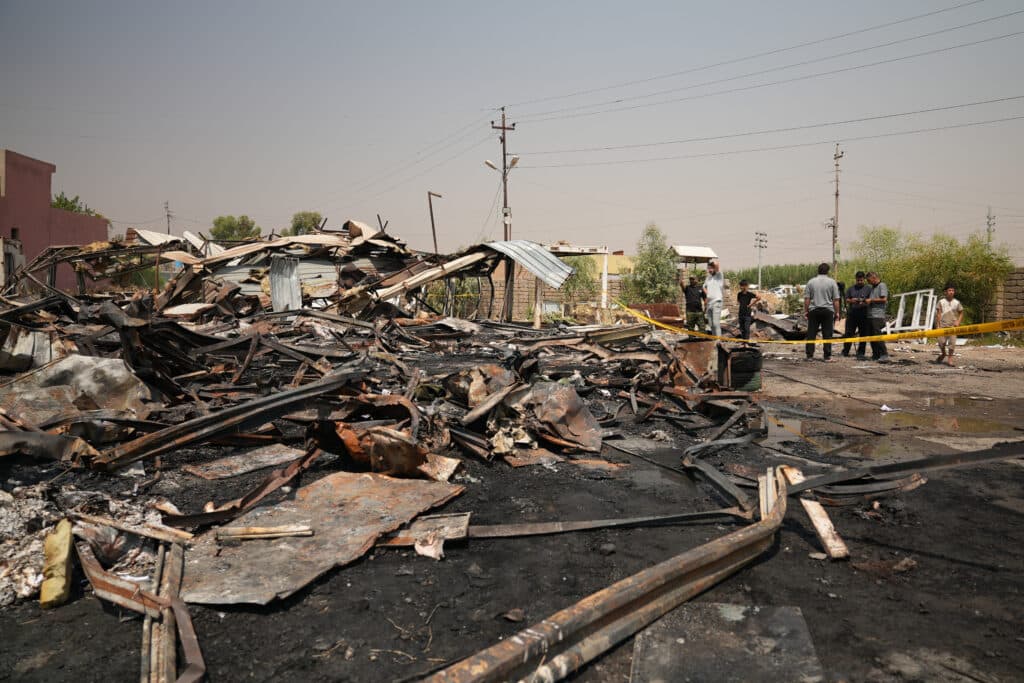
BAGHDAD: In a significant escalation of the ongoing regional conflict, coordinated airstrikes conducted by the United States and Saudi Arabia targeted multiple facilities belonging to Iraq’s Popular Mobilization Forces (PMF) on Wednesday, killing at least 20 militants and injuring dozens more.
The strikes have deepened the already profound instability in the region, drawing strong condemnation from Iraqi authorities and increasing the risk of a wider confrontation.

Details of the Airstrikes and Casualties
The PMF—a powerful coalition of former paramilitary groups and Iran-aligned Shiite factions that are now officially integrated into the Iraqi armed forces—released a statement on Wednesday detailing the extent of the damage.
According to the PMF, the overnight US-Saudi “aggression” targeted its official headquarters and facilities across seven Iraqi provinces: Baghdad, Wasit, Nineveh, Basra, Kirkuk, Karbala, and Diyala. The group reported that at least 20 of its fighters “were martyred and another 32 wounded” based on a preliminary toll. A PMF official noted that the strikes in Nineveh and Diyala provinces were the deadliest.

The operation also caused extensive material damage to PMF facilities, military vehicles, and equipment. Specialized committees have been deployed to the field to assess the full extent of the destruction, and the PMF warned that casualty figures could rise as search operations continue.
In addition to the PMF casualties, two Iraqi militia officials speaking anonymously stated that six Iranian advisers were also killed in the joint strikes, though it remains unclear if they were included in the initial death toll of 20 fighters.
The US and Saudi Rationale
The US Central Command (CENTCOM) and Saudi Arabia’s Ministry of Defense confirmed the joint precision strikes, stating they targeted Iranian-aligned groups.
The operation was launched in direct response to a series of recent attacks on US military forces and Saudi energy infrastructure. Specifically, Saudi Arabia had accused Iraqi militias of launching drone attacks against its petroleum facilities over the past two days. According to CENTCOM and Saudi statements, more than 30 drone attacks had targeted Saudi energy infrastructure and US bases in the region over a 72-hour period.
Saudi Arabia justified the military action as self-defense under Article 51 of the UN Charter and issued a stark warning that it would take further military action if Iran-backed groups continued their attacks.
The targeted groups, however, have strongly denied involvement. Iraqi militias described the Saudi accusations as “fabrications,” and an Iranian military official explicitly denied Tehran’s involvement in any projectiles launched from Bagdhad toward Saudi Arabia. The Houthis in Yemen, another Iran-backed group, separately claimed responsibility for attacking Saudi energy facilities as part of their own ongoing conflict.
Iraqi Government Reaction and Condemnation
The strikes have placed immense pressure on the Iraqi government, which constantly struggles to balance its relationships with its two main allies, Washington and Tehran.
The PMF fiercely denounced the strikes as a “dangerous escalation, a violation of Iraq’s sovereignty, and an attack on its official security institutions”.
The Baghdad presidency echoed this sentiment on Wednesday, condemning the joint US-Saudi operation. The presidency stated that “targeting official security institutions is incompatible with the rules of international law and the UN Charter”. Furthermore, the presidency reiterated its firm rejection of Iraqi territory being used as a launchpad for attacks against neighboring countries or as a proxy battleground for regional disputes, urging all parties to respect Iraq’s sovereignty.
At the provincial level, Nineveh’s Provincial Council also condemned the strikes on its territory while simultaneously rejecting the use of the province as a base for launching attacks against neighboring nations.
In response to the rapidly deteriorating security situation, Prime Minister Ali al-Zaidi ordered an emergency security meeting on Wednesday.
ALSO READ: US-Iran Strikes Intensify: Trump Bombs Tehran For 7th Straight Night
A Deepening Regional Conflict
The US-Saudi strikes on Iraq occurred amid a broader regional flare-up. Early Wednesday, Iran launched a barrage of missiles at American forces in the Middle East. Additionally, a US airstrike reportedly targeted an area near the western Iranian city of Piranshahr, close to the Iraqi border, in West Azerbaijan province.
These synchronized escalations threaten to completely derail closed-door diplomatic efforts, where mediators had recently expressed optimism about restoring a ceasefire and bringing the US and Iran back to the negotiating table.