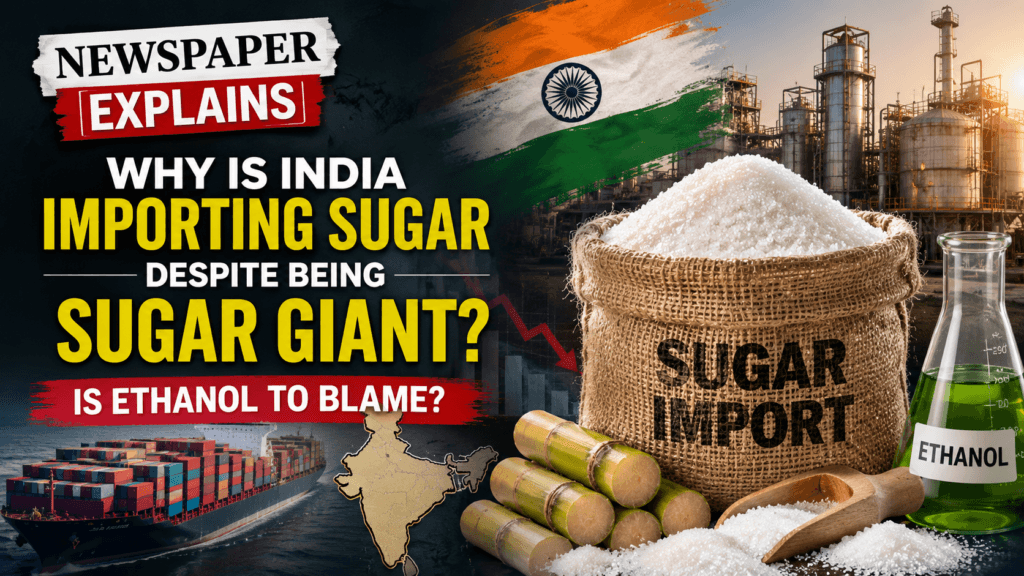
India is facing an unusual situation in 2026: the world’s second-largest sugar producer is importing sugar. The government has allowed 1 million tonnes of raw sugar to be imported duty-free, the first such major import intervention in nearly a decade, after domestic sugar prices surged sharply. The move was intended to increase supplies ahead of the upcoming festive season.
But the development has raised a bigger question: How did India go from being a major sugar exporter to importing sugar — and did the country’s aggressive ethanol push contribute to the problem. The short answer is: ethanol is part of the story, but it is not the whole story.
What Happened to India’s Sugar Supply?
The country’s sugar balance has tightened considerably. For the current marketing year, industry estimates cited by Reuters put sugar production at around 27.9 million tonnes, against domestic consumption of approximately 28–28.5 million tonnes. Around 3 million tonnes of sugar-equivalent output was diverted toward ethanol, while roughly 800,000 tonnes was exported. Opening stocks for the new season are expected to be around 3.5 million tonnes, down from about 5 million tonnes previously.

The government has separately put current-season production at around 306 lakh tonnes, about 11% below an earlier estimate of 343 lakh tonnes. Officials have argued that domestic stocks remain adequate and rejected the idea that ethanol diversion is primarily responsible for the recent price surge.
That difference in estimates is important: India does not necessarily face an absolute physical sugar shortage. The problem is a much tighter supply cushion.
So, Is Ethanol to Blame?
Partly — but blaming ethanol alone would be misleading. New Delhi’s ethanol policy has encouraged sugar mills to divert sugarcane juice, syrup and molasses into ethanol production. The government has promoted ethanol blending as a way to reduce crude-oil imports, lower emissions and provide another revenue stream for sugar mills and farmers.

Modi Government’s ethanol-blending programme had already reached close to the government’s 20% target, with blending averaging 19.05% during ESY 2024-25 as of July 2025.
Every tonne of sugar diverted toward ethanol, however, is potentially a tonne that does not enter the food-sugar market. That trade-off becomes particularly important when sugarcane production falls.
The Bigger Problem: Lower Sugarcane Output
Recent reports indicate that weather-related damage has played a major role. Excess rainfall in parts of Maharashtra, Karnataka and Gujarat affected sugarcane growth, while concerns over future weather conditions have added uncertainty to production.
So the country effectively faced two pressures at once: Less sugarcane available for processing + continued demand for ethanol. That combination leaves less flexibility for sugar mills.
ALSO READ: NITI Aayog Report: Degree But No Jobs? 8.7 Crore Indians Outside Education, Employment or Training
Why Did Sugar Prices Explode?
Indian sugar prices reportedly rose by more than 40% in roughly two months, reaching record levels before subsequently declining after the government’s import announcement. ISMA president Niraj Shirgaokar argued that speculative buying, rather than a genuine structural shortage, played an important role in the price surge.

The government therefore chose imports as a way to increase market confidence and prevent festival-season demand from pushing prices even higher. But interestingly, imports may now be much smaller than initially expected.
Reuters reported on August 25 that mills and refiners may import only around 500,000 tonnes, roughly half of the 1 million-tonne duty-free quota, because domestic prices have already fallen and importing sugar has become less profitable.
The Country Is Not Suddenly Running Out of Sugar
This distinction is crucial. India’s decision to import does not mean the country has run out of sugar.
Instead, policymakers are trying to maintain a comfortable buffer between domestic production, consumption and stocks. New Delhi has also suspended sugar exports through September 2026 as policymakers prioritize domestic availability.
The government has additionally approved the release of around 300,000–350,000 tonnes of refined sugar held by refiners into the domestic market, providing another immediate supply source.
The Real Sugar vs Ethanol Debate
India’s sugar story ultimately reflects a much bigger policy dilemma.
Sugar or ethanol?
Ethanol helps India reduce its dependence on imported crude oil and gives sugar mills an alternative revenue stream. But when sugarcane output is weak, diverting too much cane-derived material toward fuel can tighten the food-sugar balance. At the same time, reducing ethanol production could undermine India’s ambitious energy-security strategy.
Therefore, ethanol is not solely responsible for India’s sugar imports — but it has reduced the sector’s margin for error at a time when production has weakened.
The immediate crisis appears manageable, but the episode exposes a difficult question for India’s policymakers:
How much of India’s sugarcane should go into food, and how much should go into fuel? That balance could become increasingly important as India simultaneously tries to secure food supplies, farmer incomes and energy security.