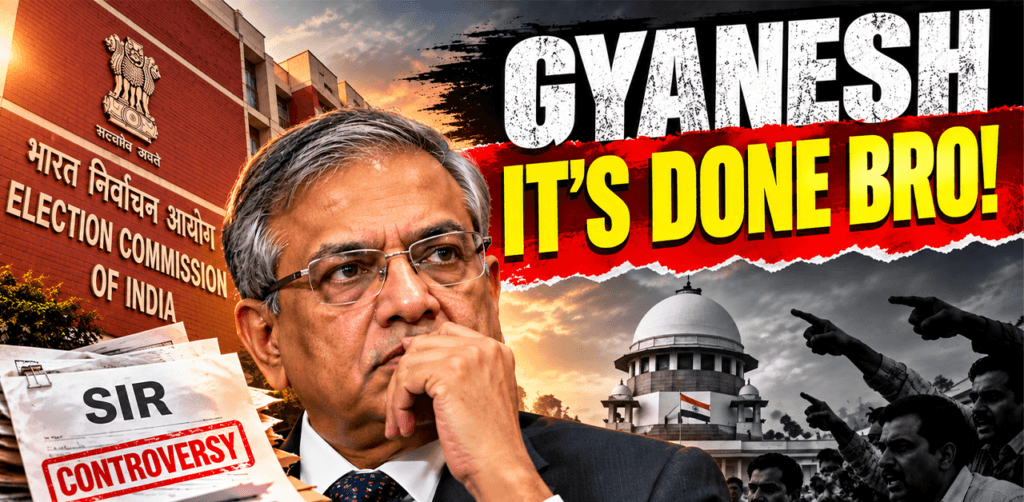
Chief Election Commissioner Gyanesh Kumar has come under increased political scrutiny amid a controversy surrounding the Election Commission of India’s Special Intensive Revision (SIR) of electoral rolls.
The controversy intensified after a report alleged that Election Commissioners Sukhbir Singh Sandhu and Vivek Joshi had raised objections on multiple occasions over decisions linked to the functioning of the poll panel and the SIR process.
The Election Commission has since issued clarifications and announced several measures, including changes to the SIR process and an extension of the Delhi deadline.
Why Is Gyanesh Kumar Facing Questions?
The immediate controversy centres on the functioning of the Election Commission during the SIR exercise. An Indian Express investigation reported that Election Commissioners Sukhbir Singh Sandhu and Vivek Joshi had formally objected on at least 14 occasions over a period of 10 months. The report said the objections covered issues including decisions concerning electoral rolls and the functioning of the Commission.

The report triggered questions from opposition parties about whether there were differences within the three-member Election Commission.
What Is the SIR Controversy?
Special Intensive Revision is a process through which electoral rolls are reviewed and updated. The controversy has centred partly on how voters are verified, how names are included or excluded and how notices and hearings are handled.
Opposition parties have alleged that the process could result in eligible voters being excluded. These are political allegations and the Election Commission has disputed the characterisation of its process.
The Commission has maintained that its decisions were unanimous and issued a detailed clarification amid reports of internal differences.
ALSO READ: Delhi SIR: 47.7 Lakh Voters Excluded In Mass Revision Of Electoral Rolls
What Did the Other Election Commissioners Say?
According to The Indian Express report, Election Commissioners Sukhbir Singh Sandhu and Vivek Joshi had raised formal objections to certain decisions. The report described objections relating to issues including electoral-roll changes and the manner in which certain decisions were taken.

The Election Commission subsequently sought to address concerns through a full Commission meeting and a detailed clarification.
What Has the Election Commission Done Now?
On September 26, the Election Commission announced several measures related to SIR. These included additional time for claims and objections, home visits by officials in specified cases, help desks and other procedural measures.
The Commission also extended the deadline for claims and objections in Delhi to October 30. In addition, the ECI ordered a review of the ECINET system. A committee headed by a senior Deputy Election Commissioner, with an independent expert from an IIT or IIIT, is expected to examine the system’s compliance with relevant laws and rules.
What Are Opposition Parties Saying?
Opposition parties, including the Congress, have intensified criticism of the Election Commission and called for accountability over the SIR process. Congress leaders have demanded Gyanesh Kumar’s resignation and questioned the conduct of the revision exercise.
These are political positions expressed by opposition parties and should be distinguished from the Election Commission’s own explanation of the process.
What Is the Election Commission’s Position?
The Election Commission has rejected suggestions that its decisions were divided and has said decisions related to the SIR process were unanimous. It has also announced procedural changes and extended deadlines in response to concerns surrounding the process.
Why Does the Controversy Matter?
The dispute matters because electoral rolls determine who is formally registered to vote. Any large-scale revision of electoral rolls therefore attracts significant public and political attention.
The central questions now concern how voter verification is conducted, how objections are handled, how electoral data is managed and whether eligible voters have adequate opportunities to correct their records.
FAQs
Who is Gyanesh Kumar?
Gyanesh Kumar is the Chief Election Commissioner of India.
Why is Gyanesh Kumar facing criticism?
He is facing political criticism amid a controversy over the Election Commission’s SIR process and reported internal objections by the other two Election Commissioners.
What is the SIR controversy?
The controversy concerns the Election Commission’s Special Intensive Revision of electoral rolls, including questions about voter verification, deletions, notices, hearings and the functioning of the Commission.
What has the ECI said about the controversy?
The ECI has said decisions related to SIR were unanimous and has announced procedural changes, including extended deadlines and a review of its ECINET system.
What is the new Delhi SIR deadline?
The deadline for claims and objections in Delhi is now October 30, 2026.