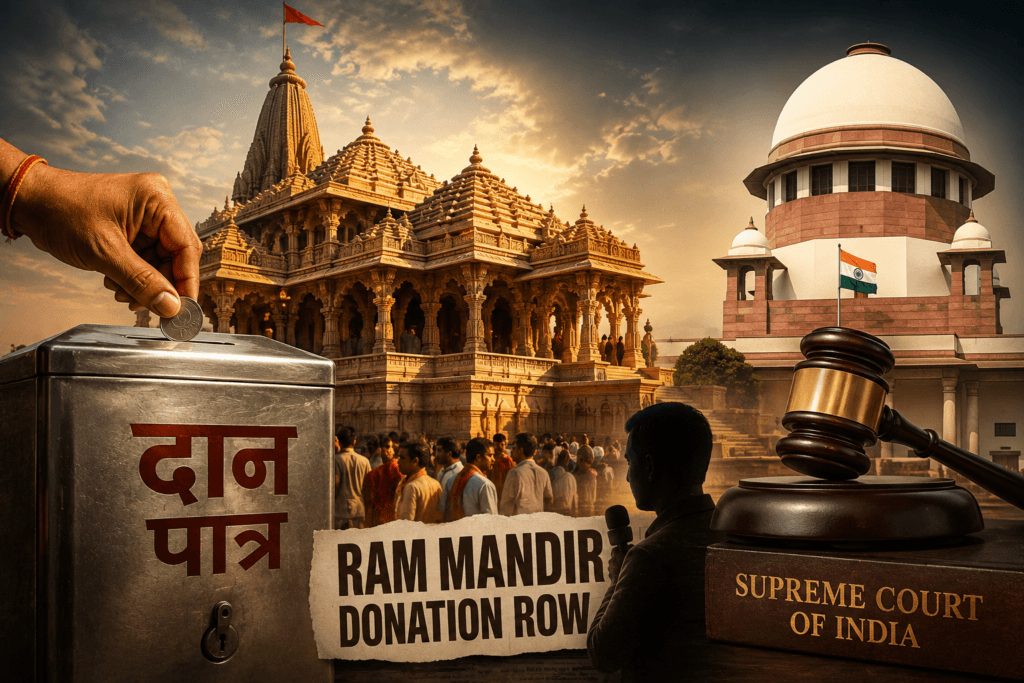
The Supreme Court of India has granted interim protection from arrest to journalist Abhishek Upadhyay, who had reported allegations concerning irregularities in the handling of donations linked to the construction of the Ram Mandir in Ayodhya.
The journalist had approached the top court challenging an FIR registered against him by Ghaziabad Police in connection with a separate road-rage case. The Supreme Court has directed him to approach the Allahabad High Court for appropriate relief, including seeking quashing of the FIR. The matter has been listed for further hearing on September 7.
Why Is the Case Connected to the Ram Mandir Donation Controversy?
Upadhyay had previously reported allegations concerning the handling of donations associated with the Ram Temple. He subsequently alleged that the police case against him was connected to his reporting and sought protection from arrest.

The Supreme Court’s latest intervention therefore brings the dispute into focus not only as a criminal-law matter but also as a question involving journalistic freedom and the consequences of reporting on sensitive religious and financial issues.
What Did the Supreme Court Order?
The Court granted interim protection from coercive action, meaning the journalist has temporary protection from arrest in connection with the case while he pursues legal remedies. The Court also directed the police to provide him with a copy of the FIR.

Importantly, the Supreme Court’s order does not establish that the allegations concerning Ram Mandir donations are true or that the FIR was fabricated. Those issues remain subject to the appropriate legal proceedings.
Why Is This Significant?
The case has attracted attention because the Ram Mandir in Ayodhya is one of India’s most politically and religiously significant institutions.Questions involving its donations can therefore quickly become politically sensitive.
At the same time, journalists reporting allegations involving powerful institutions must operate within the boundaries of defamation, criminal law and journalistic responsibility.
The Supreme Court’s intervention highlights the importance of ensuring that criminal proceedings do not become a substitute for resolving legitimate legal disputes through due process.
ALSO READ: NITI Aayog Report: Degree But No Jobs? 8.7 Crore Indians Outside Education, Employment or Training
What Happens Next?
The immediate next step is for Upadhyay to approach the Allahabad High Court, where he can seek further relief concerning the FIR. The Supreme Court has posted the matter for September 7, when the case is expected to come up again.
The wider controversy over the alleged Ram Mandir donation irregularities remains separate from the question currently before the Supreme Court. For now, the most significant development is that a journalist who reported on the controversy has received interim protection from arrest while challenging the police case against him.