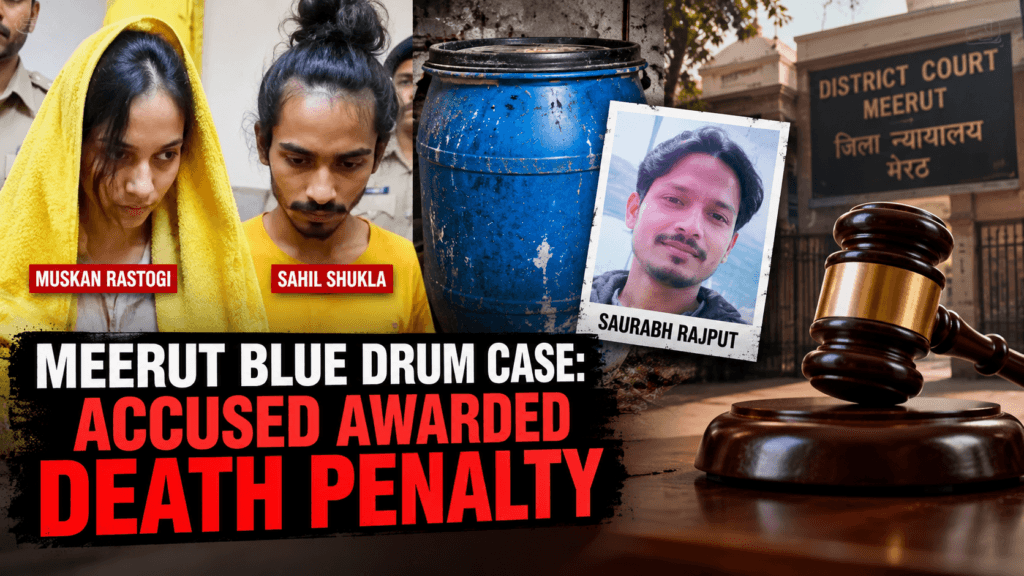
MEERUT: A court in Meerut on Wednesday sentenced Muskan Rastogi and Sahil Shukla to death for the murder of Saurabh Rajput, a merchant navy officer whose dismembered remains were concealed inside a blue drum filled with cement in a case that shocked the country.
District Judge Arvind Kumar Mishra pronounced the sentence after the court convicted the two on September 30 for the murder and destruction of evidence. Both convicts appeared before the court through video conferencing.
The verdict followed a 13-month trial involving 126 hearings and the examination of 22 prosecution witnesses. The prosecution had sought the maximum punishment, citing the nature of the crime and the attempts made to conceal the victim’s remains.
The case, widely known as the Meerut blue drum murder, came to light in March 2025 after police recovered Rajput’s remains from the couple’s residence.
What happened in the Meerut blue drum murder case?
According to the prosecution, Rajput was murdered at his home in Meerut on March 3, 2025. Muskan Rastogi, his wife, and Sahil Shukla allegedly killed him before dismembering his body and placing the remains inside a blue plastic drum. The drum was subsequently filled with cement and other material in an attempt to conceal the remains, investigators alleged.
Rajput had reportedly returned from London in February 2025 to spend time with his family. His murder and the circumstances in which his remains were discovered attracted widespread attention. Police recovered the remains in mid-March 2025. Muskan Rastogi and Sahil were arrested after returning from a trip to Himachal Pradesh.

The prosecution argued that the murder and the subsequent concealment of the body demonstrated the gravity of the offence. The defence sought leniency during the sentencing proceedings.
How did investigators circled Muskan Rastogi & Sahil Shukla?
The prosecution examined 22 witnesses during the trial, including people connected with the purchase of items allegedly used in the crime. Investigators also relied on evidence concerning the movements of the accused, including information from hotel staff and cab drivers. Records relating to their stays at different locations were presented to establish the sequence of events following the murder.
The case did not depend on an eyewitness account of the killing. Instead, the prosecution presented circumstantial evidence and witness testimony to establish the involvement of the accused.

The court convicted both Muskan and Sahil on September 30, finding them guilty of murder and attempting to conceal evidence. The sentencing hearing then considered the appropriate punishment for the offences.
ALSO READ: Rahul Gandhi, INDIA bloc move Supreme Court over voter deletions, seeks audit of electoral rolls
Why did the court award the death penalty?
The prosecution sought capital punishment, arguing that the circumstances of the murder and the subsequent dismemberment and concealment of the remains warranted the harshest sentence. The defence urged the court to show leniency, including by referring to the future and upbringing of the children involved in the family.
The court ultimately sentenced both convicts, Muskan Rastogi and Sahil Shukla to death on Wednesday. The precise reasoning behind the sentence should be assessed from the court’s written order.

Under Indian criminal procedure, a death sentence passed by a Sessions Court must be confirmed by the High Court before it can be carried out. The convicts can also pursue the available appellate remedies.
What happens next?
The sentencing order marks a major development in a case that remained under trial for more than a year. The next stage will involve the legally required High Court proceedings concerning confirmation of the death sentence. The convicts may challenge their convictions and sentences through the judicial process.
The case has drawn attention to the role of forensic evidence, witness testimony and circumstantial evidence in serious criminal trials. For now, the Meerut court’s decision represents the culmination of the trial at the Sessions Court level, while further judicial scrutiny remains part of the legal process.