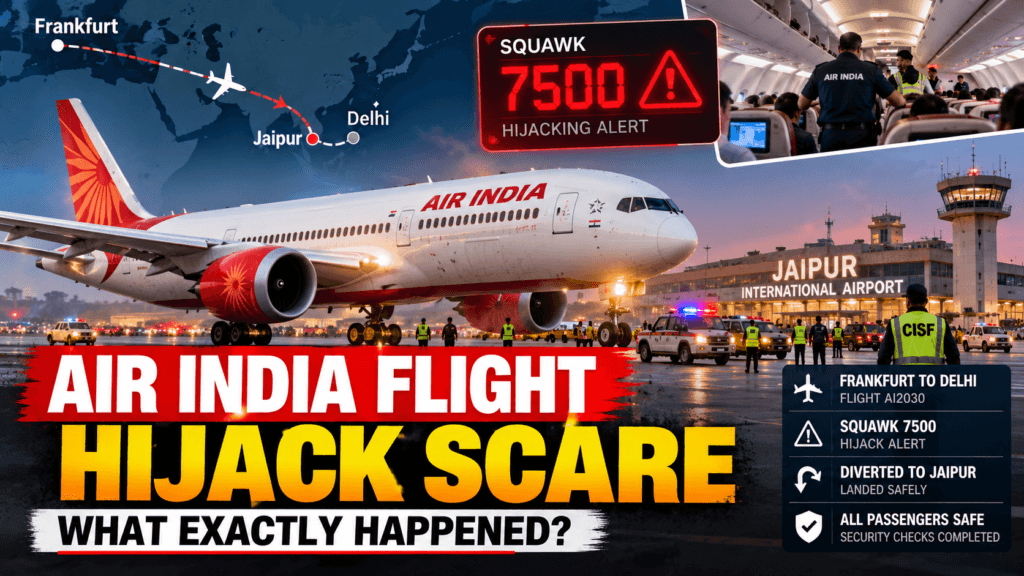
JAIPUR: An Air India flight operating from Frankfurt to New Delhi was diverted to Jaipur on Wednesday after the aircraft reportedly transmitted a hijacking alert, triggering a security response at the airport. The aircraft landed safely, all passengers and crew were accounted for, and preliminary checks found no immediate security threat.
Flight AI2030, a Boeing 787-9, landed at Jaipur International Airport at around 9.35 am after the alert prompted authorities to divert it from its scheduled route to Delhi.
The aircraft was moved to an isolation bay, where security agencies carried out checks on the plane and passenger baggage. Passengers were temporarily disembarked and screened before being allowed to reboard.
The Directorate General of Civil Aviation (DGCA) is investigating the incident. Preliminary reports indicated that the hijack alert may have been triggered by mistake, but the precise circumstances remain under investigation.
What exactly happened on the Air India flight?
The aircraft was travelling from Frankfurt, Germany, to Delhi when an emergency signal was reportedly received by Ahmedabad Air Traffic Control at around 9 am. According to initial reports, the aircraft transmitted the transponder code 7500, an internationally recognised aviation code used to indicate hijacking or unlawful interference.
The signal prompted aviation authorities and security agencies to initiate precautionary procedures. Around 9.10 am, authorities decided to divert the flight to Jaipur rather than allow it to continue directly to Delhi while the alert was being assessed.
View tweet
The Air India aircraft landed safely at Jaipur airport at 9.35 am and was moved to an isolation bay shortly afterwards. Police, Central Industrial Security Force (CISF) personnel and other security agencies were involved in the response.
The aircraft’s diversion was a precautionary measure while authorities assessed the possible threat.
What is Squawk 7500, and why did it trigger a security alert?
Squawk 7500 is a standard aircraft transponder code used to discreetly notify air traffic control of a hijacking or unlawful interference with an aircraft. Aircraft transponders transmit identification and other information to air traffic control systems. Pilots can select specific codes to communicate particular situations to controllers.
The code 7500 is associated with hijacking, while 7600 indicates a radio communication failure and 7700 indicates a general emergency .When an aircraft transmits code 7500, controllers and security agencies treat the signal seriously because they cannot immediately assume that it is accidental.
The response can include alerting airport authorities, informing security agencies, arranging for the aircraft to land at a suitable airport and preparing emergency personnel.
In the case of this Air India flight, the reported activation of the hijack code prompted the diversion to Jaipur and a detailed security inspection.
ALSO READ: Flydubai flight hijacking scare: What exactly happened inside the Israel Bound Plane?
How did security agencies respond in Jaipur?
After landing, the aircraft was moved away from the main apron to an isolation bay for security checks. Security personnel inspected the aircraft and passenger baggage. Reports said bomb-detection teams and sniffer dogs were deployed as part of the precautionary response.
Passengers were disembarked and screened before being allowed to board again after the aircraft and Air India crew were cleared by the relevant agencies. Airport authorities said the situation was normal and that passengers were safe.

Air India confirmed that the aircraft had been diverted because of a perceived security concern. The airline said the plane landed safely and that the relevant agencies carried out the necessary checks before clearing the aircraft and crew.
The airline also apologised for the disruption and said it was working with authorities to minimise inconvenience to passengers.
Was the Air India flight actually hijacked?
There was no confirmed hijacking reported as of Wednesday afternoon. The diversion was triggered by a security alert associated with the reported transmission of code 7500. Subsequent preliminary checks indicated that the aircraft was operating normally, and passengers were allowed to reboard after security screening.
Some reports cited preliminary indications that the alert may have been activated by mistake. However, the DGCA is investigating how the signal was generated and whether there was any technical or procedural error.

It is important to distinguish between a hijack alert and a confirmed hijacking. An alert triggers a precautionary response; it does not, by itself, establish that an aircraft has been seized or that passengers are in danger.
The investigation will be important in determining why the signal was transmitted and whether changes to procedures or additional safeguards are required.
What happens to the passengers and Air India flight?
Air India said passengers had undergone security checks and reboarded the aircraft after the relevant authorities cleared it.The airline was expected to resume the flight to Delhi after completing the required procedures. The diversion nevertheless caused delays and disruption for travellers who were scheduled to arrive in the national capital.
The incident also demonstrated how an aviation security alert can lead to an immediate diversion even when no physical threat has been confirmed.
For passengers, the priority was to ensure that the aircraft was safe before operations resumed. For aviation authorities, the focus shifted to determining the circumstances behind the alert.
What will the DGCA investigation examine?
The investigation is expected to establish how the transponder code was activated, whether the signal was deliberate or accidental, and whether there was any technical malfunction or communication error.
Investigators may also examine flight data, communications between the cockpit and air traffic control, and the procedures followed by the crew and authorities after the signal was received. The findings will help determine whether the incident was caused by a pilot error, a technical issue or another factor.
Until the investigation is completed, the exact cause of the hijack scare remains unconfirmed.
The safe landing of AI2030 and the clearance of its passengers and crew brought the immediate security response to a close. The focus now is on establishing why the alert was transmitted and ensuring that aviation safety procedures continue to function effectively.