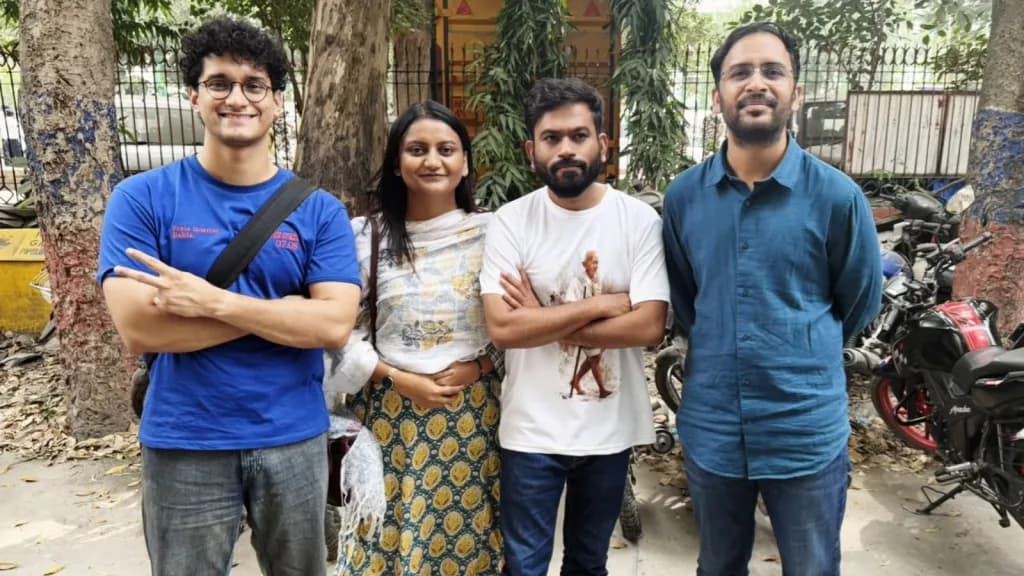
Cockroach Janata Party (CJP) leaders Abhijeet Dipke, Saurav Das and Ashutosh Ranka were released on Sunday, October 11, after a Delhi court ordered their release following their preventive detention ahead of a planned protest against Chief Election Commissioner Gyanesh Kumar.
The three leaders had been detained by Delhi Police after their flight from Mumbai landed in the national capital on Saturday. They were produced before an Executive Magistrate at Delhi Cantonment, which ordered their release subject to a condition that they maintain peace for one year. The release followed the signing of a surety bond of ₹50,000, according to police and the party’s legal team.
The detentions took place amid a major security operation in Delhi to prevent a large gathering at Jantar Mantar. The CJP has said it will continue demonstrations demanding Gyanesh Kumar’s resignation over alleged irregularities in the Special Intensive Revision (SIR) of electoral rolls.
Why were CJP leaders detained?
The CJP had planned a demonstration in central Delhi on October 10, calling for the resignation of the Chief Election Commissioner. The movement has alleged that the voter-roll revision has unfairly excluded eligible voters, an allegation the Election Commission and the ruling Bharatiya Janata Party have rejected.
Police detained Dipke, Das and Ranka shortly after their aircraft arrived from Mumbai. Delhi Police said preventive action was taken under Sections 126 and 170 of the Bharatiya Nagarik Suraksha Sanhita (BNSS), citing the need to maintain public peace and prevent potential cognisable offences.
View tweet
Section 126 concerns security for keeping the peace, while Section 170 provides for preventive arrest in specified circumstances. Police said the leaders were produced before the Executive Magistrate and released after completing the required legal procedures.
The CJP’s legal affairs head, Ratna Singh, confirmed their release and said the one-year condition required them not to breach the peace. The exact scope of the condition and its implications for future demonstrations depend on the applicable order and legal requirements.
CJP announces fresh protest call
The movement renewed its call for demonstrations on Sunday, October 11, after the previous day’s protest was disrupted by detentions and security restrictions.
CJP national organisation in-charge Ajinkya Shinde called on supporters to march towards Jantar Mantar again, saying the movement would continue until its demand for Gyanesh Kumar’s resignation was met.
View tweet
The party also urged supporters to assemble at alternative locations if police prevented access to the designated protest site. Its leadership described the detentions as an attempt to obstruct peaceful dissent and said it would continue its campaign.
Reports on Sunday indicated that a fresh protest call had been issued, although the gathering around Jantar Mantar remained subdued by midday amid a heavy security presence. The situation remained subject to police restrictions and further developments.
ALSO READ: ‘I was kidnapped’: Dhruv Rathee accuses Modi government and Delhi Police after release
What is the CJP demanding?
The CJP’s principal demand is the resignation of Chief Election Commissioner Gyanesh Kumar over the SIR exercise. The dispute concerns the verification and revision of electoral rolls and allegations that eligible voters have been removed.
The movement and other critics have questioned the transparency of the exercise and raised concerns about its impact on voting rights. The Election Commission has defended the revision process as an effort to maintain accurate electoral rolls, including the removal of duplicate, deceased and otherwise ineligible entries.

The disagreement has become a broader political and civil-liberties issue, with critics demanding greater transparency and the authorities maintaining that electoral procedures must be conducted within the law.
The number of names removed from electoral rolls has become a central point of contention. However, deletions can include different categories, such as deceased voters, duplicate entries and people who have moved, and the number of deletions alone does not establish how many eligible voters were wrongly excluded.
Security restrictions and mass detentions in Delhi
The CJP protest triggered extensive security arrangements across the capital on Saturday. Authorities restricted access to parts of central Delhi, closed Metro station gates, suspended mobile internet services in a specified area and announced train cancellations affecting New Delhi and Hazrat Nizamuddin stations.
Thousands of people were detained during the security operation, according to news reports, including students, activists and political figures. Most were subsequently released.
The restrictions generated criticism from opposition leaders and civil-society groups, who questioned whether the response was proportionate to a planned demonstration. Authorities, meanwhile, cited public-order concerns and the need to prevent a potentially disruptive gathering.
By Sunday, Metro services and mobile internet had resumed, although a significant security presence remained around central Delhi.
What happens next?
The CJP has indicated that its campaign against the voter-roll revision and its demand for the Election Commission chief’s resignation will continue. The movement’s next steps will depend on its announced programme, the conditions attached to the leaders’ release and any further decisions by police or the courts.
The release of Dipke, Das and Ranka resolves their immediate detention but does not settle the broader dispute over electoral-roll revision or the right to assemble. Any future protest will have to be assessed in light of applicable legal restrictions and public-order arrangements.
The coming days are likely to bring further statements from the CJP, the Election Commission, police authorities and political parties as the controversy continues.