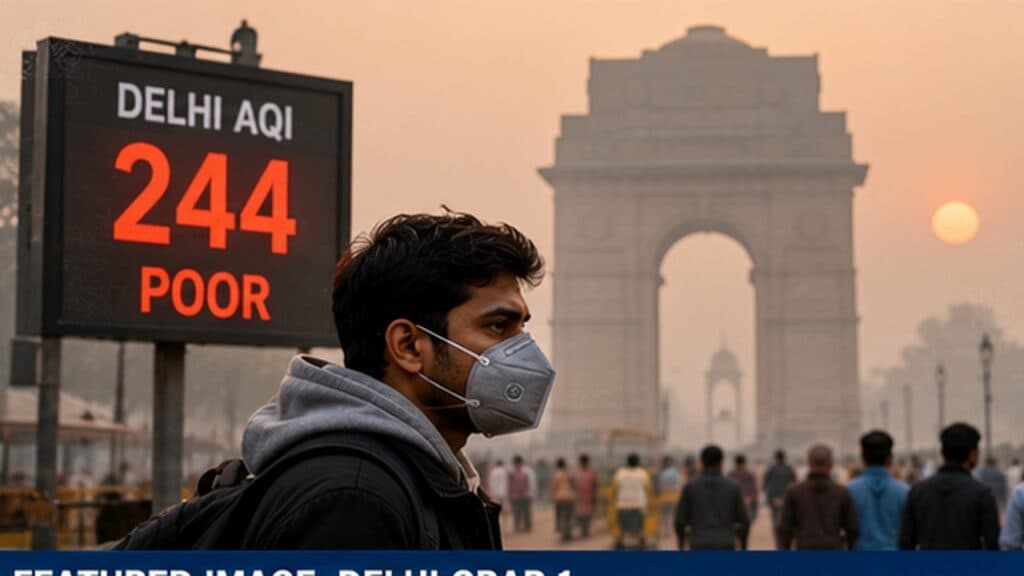
Authorities have imposed Stage I of the Graded Response Action Plan (GRAP 1) across Delhi-NCR after the national capital’s air quality deteriorated to the ‘Poor’ category, prompting renewed efforts to prevent pollution levels from worsening.
The Commission for Air Quality Management (CAQM) announced the restrictions on Wednesday after Delhi’s Air Quality Index (AQI) reached 244 at 2 pm, compared with 179 a day earlier, according to reports citing the commission.
GRAP 1 measures apply when the AQI falls between 201 and 300. The restrictions cover Delhi and the National Capital Region, including relevant areas of Haryana, Uttar Pradesh and Rajasthan.
The decision follows forecasts indicating that air quality could remain poor over the coming days. Authorities have directed enforcement agencies to step up pollution-control measures and monitor compliance.
What is GRAP 1?
The Graded Response Action Plan (GRAP 1) is a framework designed to prevent air pollution from deteriorating further in Delhi-NCR. It divides pollution-control measures into four stages based on the severity of air quality:
- Stage I — Poor: AQI 201–300
- Stage II — Very poor: AQI 301–400
- Stage III — Severe: AQI 401–450
- Stage IV — Severe-plus: AQI above 450
The measures become progressively stricter as pollution levels rise. Stage I focuses primarily on enforcing existing pollution-control rules, reducing dust emissions and discouraging activities that add to local pollution.
The imposition of Stage I does not automatically mean that schools will close or that private vehicles will be banned.
View tweet
Full list of key GRAP 1 measures
1. Ban on coal and firewood in tandoors at eateries
Hotels, restaurants and open eateries are directed not to use coal or firewood in tandoors under the Stage I restrictions.

Businesses should follow the applicable directions and use permitted alternatives where required.
2. Restrictions on diesel generator use
Authorities are directed to enforce restrictions on diesel generator sets in accordance with the applicable emissions rules and permitted exemptions.
Essential services and other specifically exempted uses may be governed by separate provisions. The exact restrictions depend on the relevant regulatory directions.
3. Dust control at construction and demolition sites
Construction and demolition activities are subject to dust-control requirements. These include measures such as covering materials, preventing dust from spreading beyond sites and ensuring appropriate handling of construction debris.

Authorities can inspect sites and take action against violations under applicable rules.
ALSO READ: Manipur Violence: Three Civilians Killed, Protests Turn Tense as Police Arrest Three Suspects
4. Mechanised road sweeping and water sprinkling
Road-owning agencies are directed to intensify mechanised sweeping and water sprinkling, particularly on heavily trafficked roads and identified dust hotspots.
The objective is to reduce the resuspension of dust, which contributes to particulate pollution.
5. Proper handling of construction and demolition waste
Construction debris must be transported and disposed of in accordance with applicable rules. Open dumping and activities that generate avoidable dust can attract enforcement action.
Agencies are also expected to identify and address vulnerable pollution hotspots.
6. Strict enforcement of vehicle pollution norms
Authorities are directed to enforce vehicle-emission standards and pollution-under-control requirements.

Vehicles that violate applicable emission rules may face penalties under existing law. Stage I should not be confused with a blanket ban on all older vehicles; specific restrictions depend on separate rules and court or government directions.
7. Control of open burning
Authorities are expected to prevent the open burning of waste, leaves and other materials, which can add to local particulate pollution.
Residents and institutions should use authorised waste-collection and disposal systems instead of burning waste in streets, parks or vacant plots.
8. Action against visible dust and local pollution hotspots
Enforcement agencies are expected to identify locations contributing to dust and emissions, including construction zones, roads, industrial areas and waste-dumping sites.
The CAQM has called for closer monitoring and implementation of the prescribed measures across the region.
Will schools remain open under GRAP 1?
Stage I does not, by itself, mandate school closures.
School-related decisions depend on the prevailing pollution situation and any additional directions issued by the authorities. If air quality worsens and stricter GRAP stages are invoked, further measures may be considered under the applicable framework.
Parents should check announcements from the Delhi government, the Directorate of Education and the relevant district administration rather than relying on unverified social media messages.
View tweet
Are private vehicles banned under GRAP 1?
No blanket ban on private vehicles follows automatically from Stage I.
Motorists must continue to comply with existing pollution-control and vehicle regulations, including applicable emissions requirements. Additional traffic restrictions, if any, must be verified through separate official orders.
If air quality deteriorates and higher GRAP stages are invoked, the restrictions may become more stringent.
Why is Delhi-NCR air pollution worsening?
Delhi-NCR experiences recurring air-quality deterioration due to a combination of emissions and weather conditions.
Major contributors include vehicle exhaust, road and construction dust, industrial emissions, waste burning and pollution transported from surrounding areas.
During periods of weak winds and unfavourable atmospheric conditions, pollutants can accumulate near the surface instead of dispersing. Seasonal agricultural-residue burning can also contribute to regional pollution during certain periods.
The relative contribution of each source changes according to location, weather and time of year. It is therefore misleading to attribute every deterioration in AQI to a single source.
What should residents do when AQI is in the poor category?
Residents can take practical precautions while authorities implement pollution-control measures:
- Reduce prolonged or strenuous outdoor exercise, especially near busy roads.
- Consider shifting outdoor physical activity indoors when air quality deteriorates.
- People with asthma or other respiratory conditions should follow their clinician’s advice and prescribed treatment.
- Keep track of official AQI updates rather than relying solely on how the air looks or smells.
- Avoid burning waste and report major sources of dust or smoke to the relevant authorities.
An AQI in the poor category can affect sensitive people as well as healthy individuals, particularly during prolonged exposure.
What happens if pollution levels rise further?
If air quality worsens, CAQM can invoke Stage II, Stage III or Stage IV measures in accordance with the GRAP framework and prevailing conditions.
Higher stages introduce progressively stronger controls. Depending on the stage and the specific orders in force, these can include tighter restrictions on construction activity, additional measures affecting vehicle use, and directions concerning schools or offices.
Such restrictions should not be assumed to be active merely because Stage I has been imposed. The public should check the latest CAQM orders for any escalation.
For now, the focus is on implementing Stage I across Delhi-NCR, reducing avoidable emissions and preventing the current deterioration from becoming more severe.