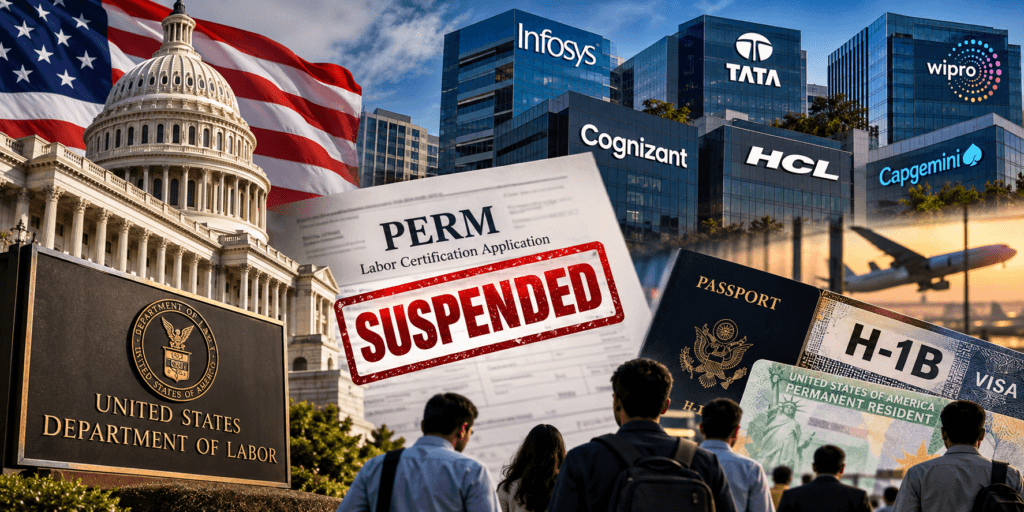
Washington: The United States has suspended several major technology and IT services companies, including Cognizant, Infosys, Tata, Wipro, HCL and Capgemini, from its Permanent Labour Certification Programme, in a major escalation of the Trump administration’s crackdown on alleged exploitation of employment-based immigration programmes.
United States Labor Secretary Keith Sonderling announced the action on Thursday, saying the Department of Labor would not accept new or process pending permanent labour certification applications involving the companies. Microsoft and Adobe have also been barred from the programme, with the department citing multiple active federal investigations in their cases.
The Permanent Labour Certification, commonly known as PERM, is a crucial step in the employment-based green card process. It requires an employer seeking to sponsor a foreign worker to demonstrate that there are no qualified and available American workers for the position and that employing the foreign worker will not adversely affect the wages and working conditions of similarly employed American workers.
View tweet
Why has the US taken action?
The move comes amid an intensified Trump admin’s campaign against what it describes as fraud and exploitation in employment-based immigration programmes, including the H-1B and PERM systems.
Sonderling said the affected IT outsourcing companies had collectively sought millions of foreign workers over the years. According to figures cited by the Labor Department, the companies had requested nearly three million foreign workers since 2009 and received more than 230,000 H-1B visa approvals and more than 100,000 permanent labour certifications.

Vice President JD Vance has also sharply criticised the dispensing of foreign-worker programmes, arguing that American companies should prioritise US workers and that immigration programmes should not be facilitated to displace American employees.
The administration’s action follows earlier scrutiny of companies’ use of H-1B visas and PERM filings. Cognizant, in particular, had already faced a suspension of its PERM filings in September as the Labor Department investigated allegations relating to its visa programmes.
ALSO READ: Nana Patekar passes away at 75: 5 Unknown Facts about the Bollywood Legend
What does the suspension mean?
The immediate impact is on the PERM process, rather than an automatic cancellation of all existing green cards or H-1B visas.
Employees whose employers are unable to file or process new PERM applications could face delays in beginning or advancing their employment-based green card cases. The PERM stage is particularly important for foreign workers who are seeking permanent residency through employer sponsorship.

However, the suspension does not automatically mean that every existing green card or immigration case associated with these companies has been cancelled. Cases that have already progressed beyond the PERM stage may be treated differently depending on their status and the terms of the government’s order.
Major implications for Indian IT professionals
The development is particularly significant for Indian technology professionals working in the United States.
Companies such as Infosys, Tata Consultancy Services, Wipro, HCL Technologies and Cognizant have historically employed large numbers of Indian professionals in the American technology sector. A prolonged freeze on PERM processing could therefore create uncertainty for employees waiting for employer-sponsored permanent residency.

For Indian nationals already working in the US on temporary employment visas, delays in the green card process can be particularly consequential because employment-based immigration involves lengthy queues and multiple stages.
The action could also force affected companies to reassess how they recruit, deploy and retain foreign workers in the US, while increasing pressure to demonstrate stronger domestic hiring and compliance with American labour requirements.
Not an H-1B ban
The suspension should not be interpreted as a blanket ban on H-1B visas for employees of the affected companies.
The latest action specifically concerns participation in the Permanent Labour Certification Programme. It prevents the companies from submitting new PERM applications and, according to the Labor Department, stops the processing of pending applications involving the affected firms.
The development nevertheless represents a significant escalation in Washington’s scrutiny of the technology industry’s reliance on foreign labour.
For Indian IT companies and their employees, the immediate question will be how long the suspension remains in place and whether the investigations result in additional restrictions on H-1B and employment-based immigration programmes.