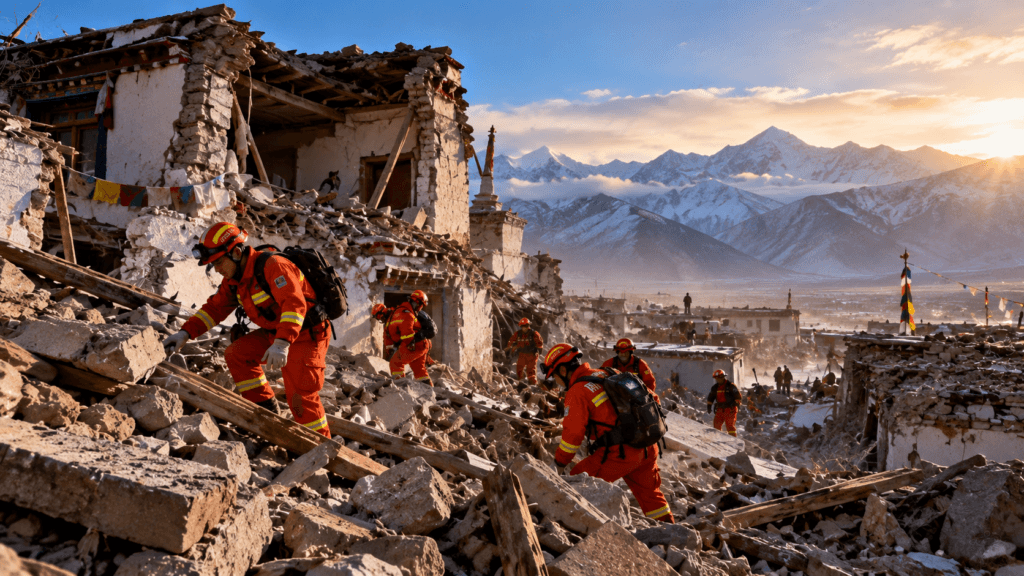
BEIJING, October 23, 2026: At least 16 people have been killed and 76 injured after a magnitude 7 earthquake struck China’s Tibet region late Thursday, damaging hundreds of homes and triggering emergency rescue and relief operations, according to local authorities.
The earthquake struck at around 10:33 pm local time on October 22 in the northern Tibetan region near Nagqu, a remote, high-altitude area. The death toll remained unchanged on Friday, while the number of injured rose as authorities continued to assess the damage.
View tweet
More than 12,000 people have been relocated to safer locations, state news agency Xinhua reported. Emergency teams have been deployed to affected communities as authorities warn that buildings weakened by the initial tremor could collapse during aftershocks.
Hundreds of homes collapse as rescue operations continue
Local authorities reported that at least 339 homes and 20 livestock sheds had collapsed in the earthquake. Rescue workers and police personnel were dispatched to assess structural damage, assist affected residents and help people move away from unsafe buildings.
More than 300 police officers, including traffic and community police personnel, were sent to the affected area, according to local authorities.
Emergency supplies, including tents, temporary housing units, folding beds, flashlights and winter clothing, were also being mobilised for displaced residents.
Residents were seen leaving their homes and taking shelter outdoors or inside vehicles following the tremor. Authorities have urged people to exercise caution around buildings with cracked walls or leaning structures.
ALSO READ: Daler Mehndi Controversy: Why Uttarakhand Minister Interrupted Singer’s Performance
Where did the earthquake strike?
The epicentre was located in a sparsely populated, high-altitude area of Nagqu in northern Tibet, around 190 kilometres east-northeast of Nagqu city, according to the United States Geological Survey (USGS). The USGS estimated the earthquake’s depth at approximately 18 kilometres, while China’s earthquake monitoring authorities reported a depth of around 10 kilometres.

The area surrounding the epicentre lies at an average elevation of approximately 4,864 metres, presenting additional challenges for rescue operations and the delivery of emergency supplies. Nagqu is located more than 300 kilometres north of Lhasa, the Tibetan regional capital.
Hundreds of aftershocks recorded
The main earthquake was followed by hundreds of smaller tremors. China’s Earthquake Networks Center reported that 413 aftershocks had been recorded as of Friday.
Authorities have warned that aftershocks could further damage buildings already weakened by the initial quake. Rescue teams are inspecting affected structures and assisting residents in relocating to safer areas.
Communications and electricity supplies, disrupted in parts of the affected region, were gradually being restored, according to local officials. A section of National Highway 317 was also closed after rockfalls, with access restricted to emergency and support vehicles while crews cleared debris.
Why is Tibet vulnerable to earthquakes?
Tibet lies on the Tibetan Plateau, a seismically active region shaped by the ongoing collision between the Indian and Eurasian tectonic plates. The resulting geological forces contribute to earthquakes across the Himalayas and surrounding areas.
The region’s high elevation, remote settlements and difficult terrain can complicate rescue efforts. Cold weather and the risk of further structural damage can also increase the challenges facing people displaced from their homes.
In January 2025, a magnitude 7.1 earthquake struck Tingri county in Tibet, killing at least 126 people and damaging homes and infrastructure. The latest earthquake has again highlighted the region’s exposure to powerful seismic events.
Rescue and relief efforts underway
Authorities are continuing to assess damage, provide emergency shelter and ensure that affected residents can access essential supplies. The relocation of thousands of people is intended to reduce the risk from damaged buildings and possible aftershocks.

The full extent of the damage remains under assessment. Rescue operations and the restoration of essential services are continuing as authorities monitor the situation.
The death toll and injury figures may change as further information becomes available.