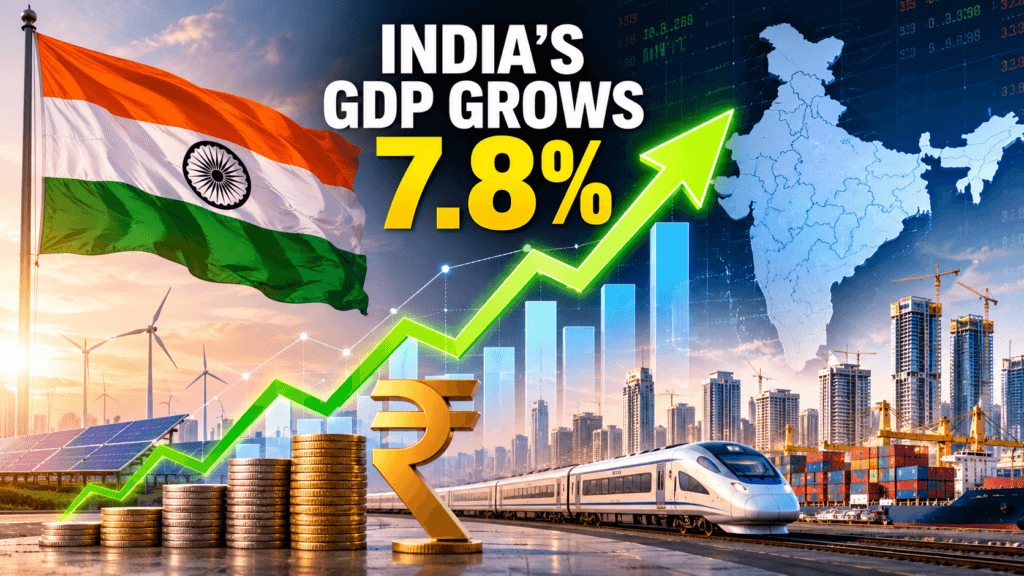
India GDP Growth Rate Updates: India’s economy has delivered a stronger-than-expected start to the 2026-27 financial year, with real GDP growing 7.8% year-on-year in the April-June quarter, beating both economists’ expectations and the Reserve Bank of India’s forecast.
The latest figure was significantly better than the roughly 7.1% growth expected by economists and the RBI’s earlier projection of 7%. It was, however, slower than the 8.6% growth recorded in the January-March quarter, which has now been revised upward.
The bigger question is not simply why India’s economy grew 7.8%. It is what is now powering that growth — and whether it can continue.
1. Private Investment Is Finally Picking Up
One of the most important developments behind the latest GDP numbers is the strengthening of private investment. Gross fixed capital formation rose 11.9% year-on-year, taking its share of GDP to around 34.3%. Reuters reported that private-sector investment is increasingly flowing into areas such as data centres, power infrastructure, semiconductors and advanced manufacturing.
This matters because India’s growth story has for years depended heavily on government-led infrastructure spending. A sustained private-capex cycle would give the economy another major engine of growth.
Strong corporate balance sheets, improving demand and increased bank lending are helping support this transition. Bank credit to industry and services has also accelerated sharply.
2. Manufacturing Is Back as a Major Growth Engine
India’s manufacturing sector expanded 9.2% in the April-June quarter. That is one of the clearest signals that industrial activity is contributing significantly to the country’s growth rather than services carrying the entire economy.
The manufacturing revival is being supported by infrastructure spending, domestic demand, investment in new production capacity and government policies designed to attract companies into electronics, semiconductors and other strategic industries.
For India, stronger manufacturing is particularly important because it has the potential to generate jobs and increase exports.
3. Services Remain India’s Biggest Strength
Manufacturing may be accelerating, but India’s enormous services economy remains central to the growth story.
The broad services sector continued to expand strongly, with financial, real-estate, IT and professional services recording particularly strong growth. Financial and related services grew around 12.1% in the quarter. This gives India an important advantage because the country is not dependent on a single economic sector.
Manufacturing, construction, financial services, technology and professional services are all contributing to the expansion.
4. Indians Are Still Spending
Domestic consumption remains another major pillar. Household consumption expenditure increased 7.1% year-on-year, according to government data. That is significant because India’s huge domestic market provides a cushion when global demand weakens.
Strong consumption supports retailers, manufacturers, transport companies, restaurants, financial services and countless small businesses. A stable monsoon and improving rural demand could provide additional support in the coming quarters, although weather conditions remain a risk.
5. Exports Added Another Layer of Support
India’s exports also performed strongly.
Government data shows exports grew approximately 12% during the quarter, while cumulative merchandise and services exports during April-July were up 13.16% year-on-year.
This is particularly notable because India’s economy is operating amid major global uncertainty, including trade tensions, geopolitical conflicts and disruptions in energy markets.
6. Government Spending Is Still Important
The government has not disappeared from the growth equation.Public infrastructure spending continues to support construction, transportation, power and related industries.
The difference now is that government spending appears to be crowding in private investment rather than acting as the economy’s only major investment engine.
That could make the current expansion more durable if the private-capex cycle continues.
But There Are Still Big Risks
The 7.8% number is impressive, but it does not mean India’s economic problems have disappeared. The biggest immediate risk is energy.
India imports more than 85% of its crude oil requirements, leaving the economy vulnerable to international oil-price shocks. The continuing conflict in West Asia and disruptions around the Strait of Hormuz could increase India’s import bill and put pressure on inflation and the rupee.
India’s current account deficit also widened to $4.2 billion, or 0.5% of GDP, in April-June, compared with $3.4 billion a year earlier, largely because of higher commodity prices and a wider merchandise trade deficit.
There are also longer-term questions around employment, productivity and whether India’s rapid GDP expansion is creating enough high-quality jobs.
Can India Sustain 7%+ Growth?
That is the real test. The latest numbers suggest India’s growth engine is becoming broader. Consumption remains strong. Manufacturing is accelerating. Services continue to dominate. Exports are expanding. And, perhaps most importantly, private investment is showing signs of returning. That combination is encouraging.
But sustaining growth at 7% or above will depend on whether India can maintain investment momentum while controlling inflation, managing energy shocks and expanding employment. For now, however, the message from the GDP data is clear:
India’s economy is not merely growing fast — its growth engine is becoming more diversified.
And if the private investment cycle continues, the 7.8% GDP figure could prove to be more than just a one-quarter surprise.
Tags: India GDP 2026, India GDP growth 7.8%, Indian economy, Q1 FY27 GDP, India manufacturing growth, private investment India, Indian economy 2026, India services sector, GDP growth India, Indian economic growth