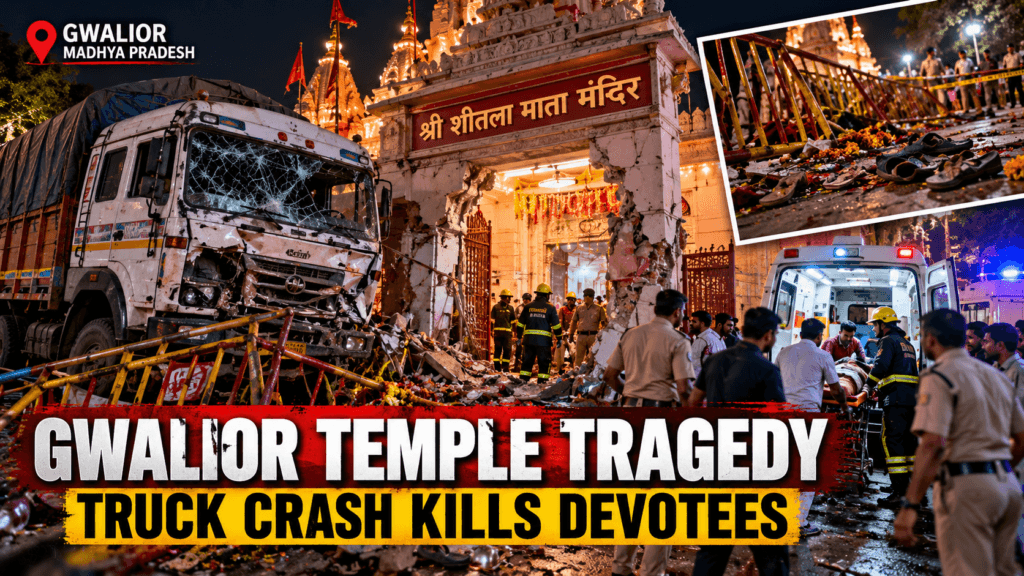
A devastating truck accident near the Sheetla Mata Temple in Madhya Pradesh’s Gwalior district has triggered questions over public safety and police arrangements after a heavy vehicle ploughed into devotees gathered for Navratri prayers, killing at least 15 people and injuring dozens.
Reports on Monday indicated that the death toll may have risen to 16, although casualty figures have varied across updates. Authorities should be consulted for the latest confirmed count as rescue, medical and investigative work continues.
The accident occurred at around 1.30 am on Sunday on the Chhinor Road, when a truck carrying paddy reportedly broke through barricades and entered a restricted stretch crowded with devotees. The vehicle ran over people and struck roadside stalls before crashing into the temple’s entrance gate, damaging the structure.
How did the Gwalior temple accident happen?
According to preliminary accounts, the truck was travelling downhill towards the temple when the driver lost control. Investigators have examined the possibility of brake failure, while officials have also focused on how the vehicle entered a zone where heavy vehicles were prohibited.

The incident took place during the Navratri celebrations, when devotees from Gwalior and nearby districts had gathered at the shrine. The large number of people on the road magnified the impact of the crash.
View tweet
Emergency teams and police rushed to the spot to rescue the injured and transport them to hospitals. Several injured people were reported to be in serious condition in initial accounts.
The precise sequence of events, including whether mechanical failure, driver error or lapses in traffic management contributed to the tragedy, remains subject to investigation.
Police action after allegations of negligence
The tragedy has prompted administrative action in Madhya Pradesh. Chief Minister Mohan Yadav ordered the removal of a Gwalior City Superintendent of Police from the post and the suspension of eight other police personnel over alleged negligence.
The chief minister also ordered a detailed investigation to establish responsibility and examine the security arrangements in place around the temple.
The key question facing investigators is how a loaded truck was able to reach a crowded, restricted road despite barricades and restrictions on heavy vehicles.
The findings could determine whether the incident was primarily caused by a vehicle malfunction or whether failures in enforcement and crowd management also played a role.
Compensation announced for victims
The Madhya Pradesh government announced financial assistance of Rs 4 lakh for the families of those killed and compensation for injured victims. The chief minister also said that injured people would receive medical assistance.
The Prime Minister’s Office separately announced ex-gratia assistance of Rs 2 lakh from the Prime Minister’s National Relief Fund for the next of kin of each deceased person and Rs 50,000 for those injured.

The announcements are intended to provide immediate support to affected families, but questions over accountability and preventive measures remain central to the investigation.
Temple committee raises security concerns
The temple management committee and some local residents have raised concerns about the vehicle’s entry into the restricted area and called for a thorough investigation.
Some reports have also carried allegations from the temple committee suggesting a possible deliberate attack. However, no publicly established forensic evidence in the reporting reviewed confirms a terror attack. The allegation should not be treated as a finding of the investigation.
View tweet
Authorities must establish the truck’s route, the circumstances in which it crossed the barricades and whether any individual or official failed to follow safety procedures.
ALSO READ: Shots Fired at Tiger Shroff: What Exactly Happened in Mumbai? Three Suspects Held
Why the Gwalior tragedy raises wider safety questions
The accident has once again highlighted the risks faced by large gatherings at religious sites, particularly when crowds share narrow roads with vehicles or when access restrictions are not effectively enforced.
Preventive measures can include stronger physical barriers, designated pedestrian routes, vehicle checks at entry points, traffic diversions and adequate deployment of personnel during major religious events.
The investigation will be closely watched by residents and victims’ families seeking clarity on how the truck reached the crowd and whether the tragedy could have been prevented.
For now, the priority remains the treatment of injured devotees, support for bereaved families and a transparent investigation into the circumstances of the crash.
Tags: Gwalior accident, Gwalior Temple Accident, Gwalior Devotees Crash