The July 2026 resignation of Union Education Minister Dharmendra Pradhan following widespread turmoil over the NEET-UG examination leaks has renewed interest in this tradition. Below is a detailed analysis of major Indian Union Ministers who resigned taking moral responsibility for crises under their watch.
In parliamentary democracies, the act of a minister stepping down to accept “moral responsibility” represents the highest benchmark of executive accountability. While political resignations in India are often driven by coalition friction, corruption charges, or party reshuffles, instances where a Union Minister voluntarily or preemptively steps down over systemic failures or public outcry remain rare and defining moments in Indian political history. But before Dharmendra Pradhan there were ministers who have resigned voluntarily on moral grounds.

Major Historic Resignations on Moral Grounds
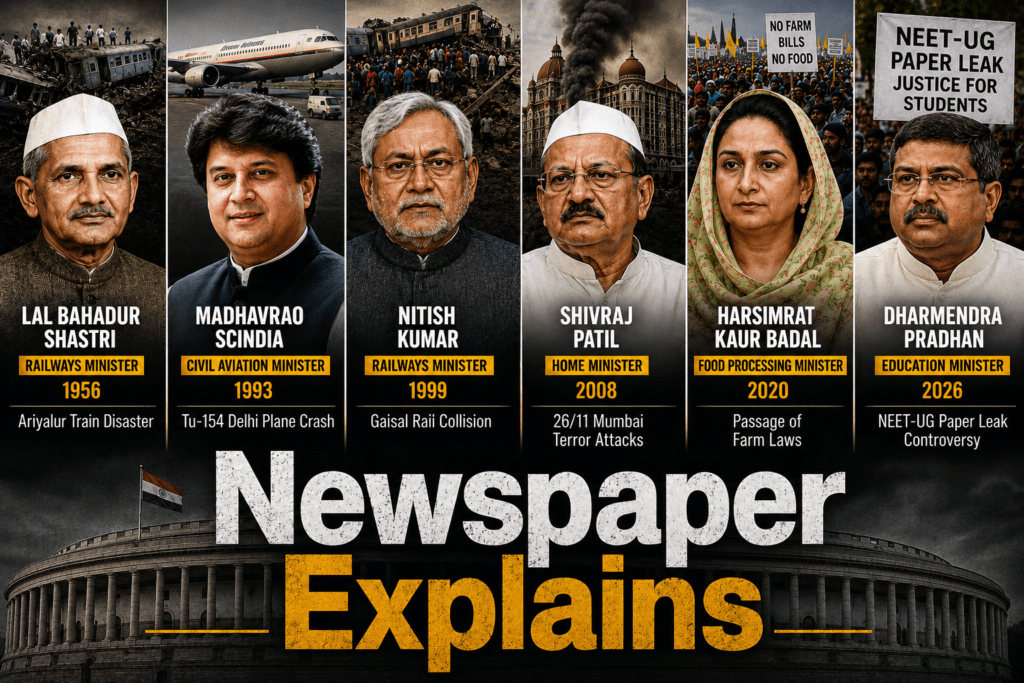
Lal Bahadur Shastri — Union Railway Minister- August & November 1956

Setting the gold standard for parliamentary accountability, Lal Bahadur Shastri tendered his resignation twice within four months following major train disasters. After the Mahbubnagar rail bridge collapse in August 1956 killed 112 people, Prime Minister Jawaharlal Nehru rejected his offer. However, when the Ariyalur train disaster occurred in November 1956, claiming over 140 lives, Shastri insisted on stepping down. Nehru accepted it, praising Shastri’s high standards of public ethics.
Madhavrao Scindia — Union Civil Aviation Minister- January 1993
Following an accident at New Delhi’s Indira Gandhi International Airport involving an Uzbek Airways Tu-154 aircraft leased by Indian Airlines, Madhavrao Scindia immediately tendered his resignation to Prime Minister P.V. Narasimha Rao. Scindia declared that as the political head of the ministry, he was taking full moral responsibility for safety standards, despite no technical fault being personally attributed to him.

ALSO READ: Rajnath Singh’s 2015 “NDA Ministers Don’t Resign” Remark Goes Viral After Dharmendra Pradhan’s Exit
RECOMMENDED FOR YOU: India On Top: Anahat Singh Wins 2026 World Junior Squash Championship, PM Modi Congratulates
Nitish Kumar — Union Railway Minister- August 1999

In one of the deadliest rail disasters in Indian history, two trains collided head-on at Gaisal station in West Bengal, resulting in over 285 fatalities. Nitish Kumar, serving as Railway Minister in the Atal Bihari Vajpayee government, immediately accepted moral responsibility for the signaling and operational failure, handing in his resignation despite reluctance from the Prime Minister.
Shivraj Patil — Union Home Minister- November 2008

In the wake of the coordinated 26/11 terrorist attacks in Mumbai, which laid bare critical intelligence and homeland security gaps, Union Home Minister Shivraj Patil faced intense national backlash. On November 30, 2008, Patil submitted his resignation to Prime Minister Manmohan Singh, stating he took moral responsibility for the security lapse that cost over 160 lives.
Harsimrat Kaur Badal — Union Food Processing Minister- September 2020

Demonstrating moral and political accountability toward her constituency, Harsimrat Kaur Badal resigned from the Narendra Modi cabinet in protest against the three farm bills being introduced in Parliament. Stating that she could not support legislation opposed by hundreds of thousands of farmers in Punjab, her exit marked a rare cabinet resignation over policy disagreement and solidarity with public protests.
Dharmendra Pradhan — Union Education Minister- July 2026

Stepping down amid nationwide student agitations over the NEET-UG 2026 paper leak and testing irregularities, Dharmendra Pradhan became only the second Cabinet Minister to resign under public pressure in the Modi era. In his resignation letter, Pradhan cited his responsibility to safeguard the trust of the nation’s youth, restore institutional credibility to national examination bodies, and prevent political deadlock.
Comparative Overview
| Minister | Portfolio | Year | Crisis / Trigger | Immediate Outcome |
| Lal Bahadur Shastri | Railways | 1956 | Ariyalur Train Disaster | Resignation accepted; set national precedent |
| Madhavrao Scindia | Civil Aviation | 1993 | Tu-154 Delhi Plane Crash | Resignation accepted by PM P.V. Narasimha Rao |
| Nitish Kumar | Railways | 1999 | Gaisal Rail Collision | Resignation accepted; later rejoined cabinet in 2001 |
| Shivraj Patil | Home Affairs | 2008 | 26/11 Mumbai Terror Attacks | Replaced by P. Chidambaram to overhaul security |
| Harsimrat Kaur Badal | Food Processing | 2020 | Passage of Farm Laws | Akali Dal withdrew from NDA coalition |
| Dharmendra Pradhan | Education | 2026 | NEET-UG Paper Leak Controversy | Quelled Jantar Mantar student protests |
Defining “Moral Responsibility” in Governance
Dharmendra Pradhan’s resignation has once again led to the widespread debate of defining moral responsibility in governance. Moral responsibility in executive governance implies that a minister takes personal accountability for a failure, disaster, or lapse that occurred within their jurisdiction—even if they were not individually at fault or directly involved in the execution.
This precedent was set early in Independent India’s history and has periodically resurfaced during times of severe institutional, security, or humanitarian crises. Lal Bahadur Shasti To Dharmendra Pradhan, resignations in a democracy show that ministers can be held accountable.