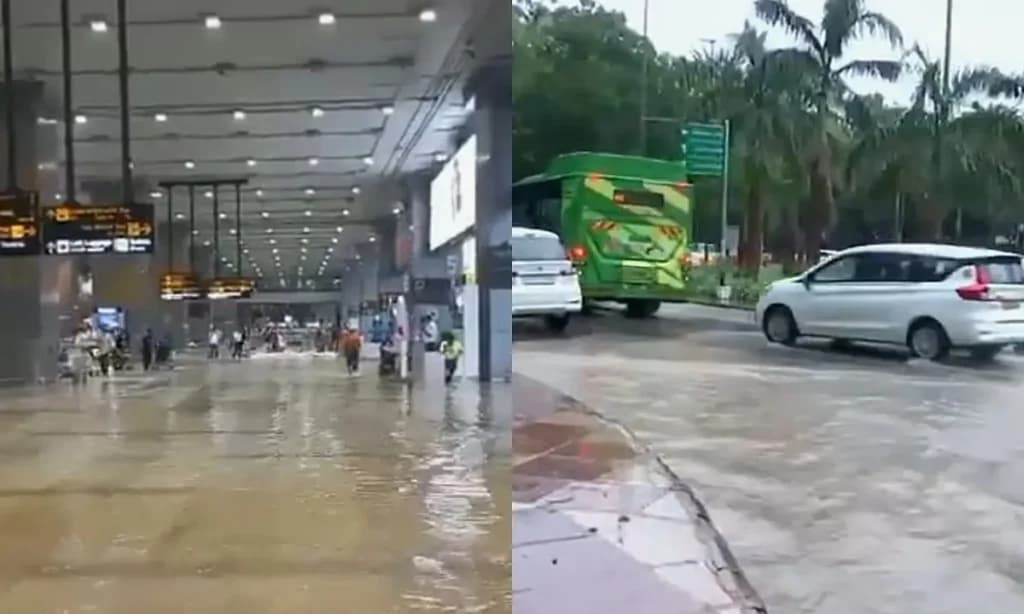
Delhi Airport Viral Video: Delhi’s Indira Gandhi International Airport — one of India’s most important aviation hubs — was hit by severe waterlogging on Friday after intense rainfall battered the national capital. Videos from the airport showed passengers pushing luggage trolleys through ankle-deep water near the terminal area, turning one of India’s most modern-looking infrastructure projects into a symbol of the capital’s recurring monsoon problems.
The disruption was not limited to passengers. At least nine flights were diverted between 3:30 pm and 4:30 pm, while more than 400 flights were delayed at Delhi Airport, according to flight-tracking data cited by Hindustan Times.
Delhi Airport Flooding Exposes Infrastructure Reality?
The India Meteorological Department issued a red alert for Delhi, warning of heavy rainfall, thunderstorms, lightning and strong winds. Some locations were forecast to receive 50–100 mm of rain in a short period. That raises an important question: Was this simply an extreme-weather event, or does it expose deeper weaknesses in urban drainage and flood management?
Delhi has repeatedly struggled with waterlogging during intense rainfall. Roads, underpasses and low-lying neighbourhoods can quickly become inundated, disrupting traffic and public transport. The airport episode brings that problem directly into the country’s flagship infrastructure ecosystem.
ALSO READ: FSSAI Slaps 9 Notices to Swiggy Instamart Over Shocking Violations
From Smart Airport to Flooded Forecourts
Waterlogging was reported around the approach roads and forecourts of Terminals 2 and 3 of the International Delhi Airport, while passengers faced difficulty reaching terminal entrances. For an airport handling more than 1,300 flight movements a day, even temporary disruption can create a cascading effect across India’s aviation network.

And the problem isn’t just about inconvenience. Airports depend on interconnected infrastructure — drainage, roads, access routes, power, ground operations and airside systems. When one component is overwhelmed, delays can rapidly spread.
India’s Infrastructure Test
The Delhi airport flooding comes at a time when India is investing heavily in highways, airports, metro networks and urban redevelopment. But extreme rainfall is becoming an increasingly important test of whether infrastructure is being designed not only for normal conditions, but also for increasingly intense weather events.
The bigger challenge is therefore not simply removing water after every downpour. It is creating cities and transport hubs where drainage capacity, flood management and climate resilience keep pace with rapid urbanisation.
The Bigger Picture
The images from Delhi Airport are powerful because they create a stark contrast: a globally connected airport surrounded by infrastructure struggling to cope with rainwater. But the incident should not automatically be interpreted as proof that India’s entire infrastructure system is failing.
Instead, it highlights a more specific problem — India’s infrastructure ambitions are growing rapidly, while urban resilience and drainage remain critical weak points. For Delhi, the question after the waters recede is simple:
Can the capital build infrastructure that doesn’t just look world-class — but actually performs like it when the weather turns extreme?